Smarter Charging for Electric Buses: How Optimization Makes Sustainable Transit Possible
As cities invest in electric buses, cleaner transportation is only part of the challenge. Behind every successful fleet lies a complex operational question: how can dozens or even hundreds of buses be charged efficiently while ensuring that every vehicle is ready for its next route?
The Challenge of Charging an Electric Bus Fleet
Unlike conventional buses, which can be refuelled in a matter of minutes, electric buses require careful charging planning. Each vehicle may return to the depot at a different time, with a different battery level, and must be ready for its next scheduled departure.
At the same time, the depot must operate within several practical constraints:
- a limited number of charging stations,
- maximum charging power for each charger,
- different arrival and departure times for every bus,
- limited electrical capacity supplied by the local grid,
- peak electricity demand during certain hours, and
- target battery levels that every bus must reach before departure.
These interconnected requirements make the scheduling problem far too complicated to solve manually once the fleet becomes large.
Turning Operations into an Optimization Problem
Instead of relying on simple rules such as “charge the first bus that arrives,” the charging process can be formulated as a mathematical optimization problem.
The objective is to determine charging schedules that satisfy all operational constraints while using the available infrastructure as efficiently as possible. Depending on the operator's priorities, the model may seek to:
- minimize total charging time,
- reduce peak power demand,
- balance electrical load across the depot,
- maximize charger utilization,
- preserve operational flexibility, and
- leave capacity available for future grid services.
At the same time, every bus must reach its required battery level before departure, charger limits must never be exceeded, total depot power must remain within grid capacity, and all charging rates must follow the equipment's supported power levels.
Why the Problem Becomes So Large
Imagine a depot with 100 electric buses. Each bus may have hundreds or even thousands of feasible charging schedules, depending on its arrival time, departure time, battery capacity, initial state of charge, available chargers, and the power available throughout the day.
Evaluating every possible combination of schedules would create an astronomically large search space. Even powerful computers would require an impractical amount of time to examine every option.
A Smarter Solution: Column Generation
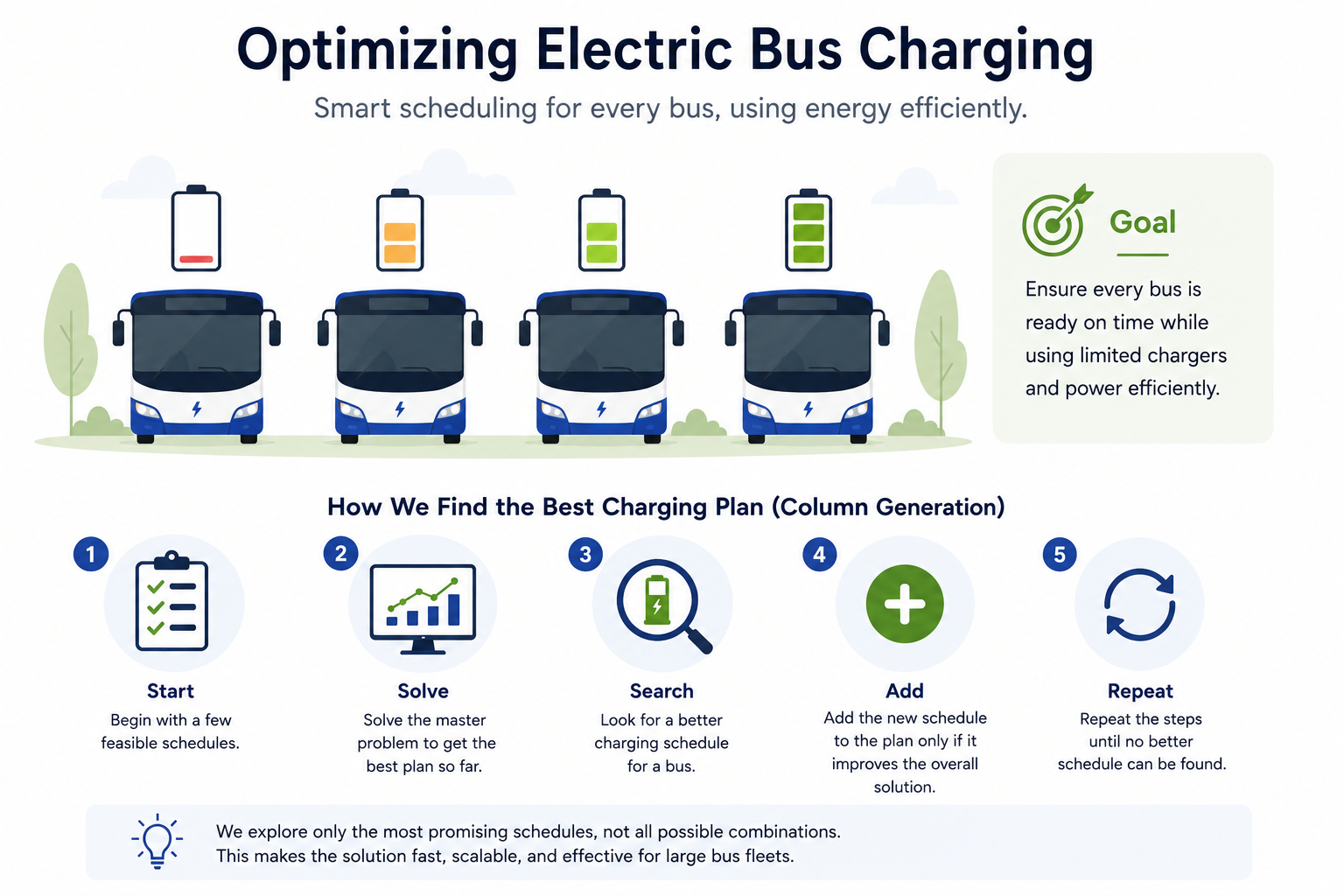
Column Generation is an advanced mathematical optimization technique designed for problems with extremely large numbers of possible decisions. Rather than considering every charging schedule from the beginning, it starts with only a small set of feasible schedules.
- Generate an initial feasible charging plan.
- Solve a simplified master problem using the current schedules.
- Search for a better charging schedule for one or more buses.
- Add only the schedules that improve the overall solution.
- Repeat until no better schedules can be found.
This approach allows the algorithm to focus only on the schedules that truly matter instead of wasting time evaluating millions of poor alternatives. The solution is built step by step and continuously improved until an optimal or near-optimal plan is reached.
Behind the Scenes: Two Problems Working Together
The Master Problem
The Master Problem determines which charging schedule should be assigned to each bus while ensuring that the depot remains within its physical and operational limits.
It coordinates fleet-wide requirements such as charger availability, depot power capacity, bus departure deadlines, and interactions between the schedules of different buses.
The Subproblem
The Subproblem focuses on an individual bus. Its role is to determine whether a better charging schedule exists for that bus under the conditions produced by the current Master Problem solution.
When a better schedule is found, it is added to the Master Problem. By repeatedly exchanging information between the Master Problem and the Subproblem, the algorithm converges efficiently toward a high-quality charging plan.
Why This Approach Works So Well
Column Generation is widely used in large-scale scheduling and logistics because it avoids unnecessary computation. Instead of solving an enormous model all at once, it generates only the most promising schedules.
This provides several important advantages:
- it scales efficiently to large electric bus fleets,
- produces high-quality schedules within practical computation times,
- makes better use of existing charging infrastructure,
- reduces peak electricity demand,
- improves charger utilization, and
- ensures buses are sufficiently charged before departure.
The key idea is simple: explore only the most promising schedules rather than every possible combination. This makes the solution faster, more scalable, and more effective for large fleets.
Beyond Charging: Smarter Energy Management
An optimized charging schedule provides benefits beyond keeping buses on the road. By balancing charging demand throughout the day, transit operators can reduce strain on the electrical grid and lower operating costs.
Unused electrical capacity may also be reserved for participation in electricity markets or ancillary grid services, creating possible new revenue opportunities without compromising reliable fleet operations.
As renewable energy and battery storage become more common, optimization will play an increasingly important role in coordinating energy generation, storage, and vehicle charging across modern transport systems.
Driving the Future of Electric Mobility
Electric buses are transforming public transportation, but their success depends on more than batteries and charging stations. Intelligent scheduling is essential for using infrastructure efficiently, controlling operating costs, and ensuring that every bus is ready when needed.
By combining mathematical optimization with advanced techniques such as Column Generation, transit operators can solve charging problems that would otherwise be impossible to manage manually.
While passengers simply see buses arriving on time, sophisticated optimization algorithms are working quietly behind the scenes—making electric public transportation cleaner, smarter, and more reliable every day.